
CAREER ANSWERS
How to Move From Customer Success to Product Manager
Start with one product role you would seriously consider. Map your customer success experience to its responsibilities, identify the product decisions you have not yet demonstrated, and test one of them through a small, permitted assignment or an original work sample. Use the result to decide whether to pursue an internal move, prepare external applications, or keep exploring.
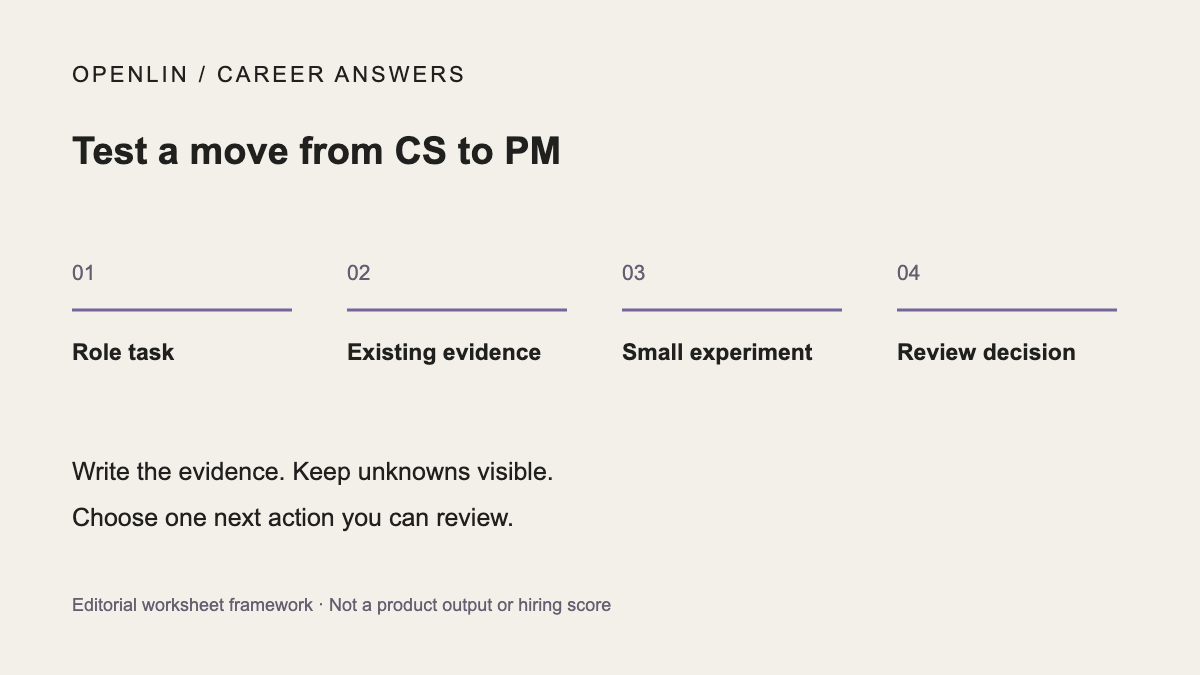
Start with the work you want to test
Customer success managers can bring useful product knowledge, customer context, and experience coordinating people. A transition also calls for evidence that you can choose among competing problems, work through tradeoffs, and evaluate an outcome. The amount and kind of evidence depend on the particular employer and level.
This guide gives you a way to make that comparison. You will leave with a target-role evidence map, one bounded experiment, and a decision about your next step. It does not predict a hiring outcome or a transition date.
Decide whether you want the product work
Think about the parts of customer success you want to keep. Do you enjoy understanding why users struggle, examining patterns across accounts, and working with a team on a reusable solution? Those are useful reasons to investigate product management.
Then look at the work you would be taking on. A product decision can disappoint a customer whose request you understand well. You may have to recommend a smaller solution, postpone a feature, or stop an initiative when the evidence changes. You will need to explain the decision to people who have different goals.
GitLab's public product-manager description, for example, assigns PMs responsibility for choosing problems, product direction, tradeoffs, and outcomes. Its customer-success description emphasizes adoption, customer outcomes, onboarding, and coordination. These are one company's role definitions, with overlap between them. They do not establish a universal boundary for every CS or PM job. GitLab product-manager role and customer-success role.
Before committing to a transition, answer these questions using a real opening or a conversation with someone doing comparable work:
- Which decisions would I own, and which would remain with engineering, design, sales, or a product leader?
- Would I enjoy deciding what to leave out as much as proposing what to build?
- How much customer contact, analysis, writing, and delivery coordination does this team expect?
- What happens when a large customer's request conflicts with the team's priorities?
- Does the job fit the income, benefits, location, and schedule I need to protect?
If your main goal is fewer customer conversations, check that assumption directly. PM work can still involve substantial customer contact. If your strongest interest is improving customer processes or coordinating implementation, compare those specific opportunities too. You do not need to choose PM to make good use of your experience.
Use the career-change guide to record the conditions a move needs to preserve.
Move from a customer request to a product decision
A customer asking for a dashboard has given you a starting point. Before recommending a build, you need to understand the task they are trying to complete, how they handle it today, and what happens when they cannot.
Consider a request for a weekly export. The underlying problem might be preparing a compliance review, sharing information with a manager, or moving data into another system. Each explanation could lead to a different solution. One customer's request also leaves questions about other users, commercial value, technical constraints, and the work a team would have to postpone.
Try writing a short decision note with these fields:
- The user and the task they need to complete
- The evidence that the problem exists, including who is missing from the sample
- At least two plausible responses, including a lower-effort option
- The reason to prefer one response under the current constraints
- A measurable sign of progress and a reason to change course
Customer advocacy helps you understand and represent a need. Prioritization adds an explicit choice about which needs to address, for whom, and at what cost. Some CSMs already make these choices in their work. If you do, describe your actual scope rather than assuming the title hides it.
Build a CS to PM evidence map
Choose one target responsibility at a time. A useful claim names your contribution and what it supports. Keep its limits beside it.
The examples below are suggested ways to examine your experience. They are an editorial worksheet, not an employer hiring rubric or a readiness score.
Swipe or scroll horizontally to see every column. Keyboard: focus the table and use the arrow keys.
| Experience to examine | Product responsibility it may support | Evidence to prepare | Limit to check |
|---|---|---|---|
| Investigating why an account struggled with onboarding | Framing a user problem | Your questions, what changed your understanding, and a shareable summary of the problem | One account may not represent the target segment |
| Grouping recurring customer feedback | Synthesizing discovery inputs | Your grouping method, competing explanations, and a recommendation | Request counts alone do not establish priority or business value |
| Reviewing adoption or usage data | Defining and interpreting an outcome | Metric definition, population, period, and a decision the analysis informed | A change after your action does not by itself prove causation |
| Coordinating a product escalation | Cross-functional collaboration | Your contribution, constraints raised by others, and the decision reached | Coordination may not show ownership of the roadmap or technical design |
| Choosing which onboarding problem to address first | Prioritization under constraints | Alternatives considered, effort assumptions, and what you deferred | The scope may differ from allocating engineering capacity |
Keep your job title accurate. If you contributed to discovery while working in CS, say that. If a PM made the final decision, identify your recommendation and their decision separately. A truthful description of a narrow contribution is easier to defend than a broad claim of product ownership.
Use permitted, shareable material. Customer records, internal roadmaps, support tickets, and screenshots may contain confidential information. Removing names does not automatically make them safe to share. When permission is unclear, create an original fictional example and label it clearly.
For a fuller record, use the transferable-skills worksheet.
Check the requirements of the specific opening
Compare openings at a similar level and in a product area you understand. Record the employer, location, role scope, source, and date. Separate stated requirements from preferred qualifications and questions you still need to resolve.
The differences can be substantial. When checked on October 5, 2026, Fleetio's Growth PM listing asked for three to five years of product-management experience and experience with product-led growth or experimentation. It listed reading and writing SQL as a plus. That is a requirement pattern for this opening, rather than a rule that every PM must know SQL. Fleetio Growth PM listing.
Atlassian's Principal PM opening for DX System Insights asked for seven or more years of PM experience and ownership of a significant analytics or data-product portfolio. It illustrates why a principal-level role should not become the default benchmark for a first product move. Recheck both postings before using them; availability and requirements can change. Atlassian Principal PM listing.
Classify what is missing before choosing a course:
- A skill gap means you need to learn or practice a task, such as defining an activation metric.
- A proof gap means you have done relevant work but need a clear, credible account of it.
- An experience or scope gap means the role asks for ownership, complexity, or delivery history your sample does not establish.
- An eligibility question means a stated qualification, location condition, or other requirement needs checking.
Learning SQL can address a specific analytical gap. It cannot turn a practice exercise into years of product ownership. Use the target-role skill-gap guide to choose which gap is worth addressing first.
Choose an internal or external path
An internal move can let people assess work in a product and customer context they already know. It still depends on team needs, available scope, your current responsibilities, and an actual decision process. Do not assume that extra work will lead to a transfer.
Ask your manager and a relevant product counterpart about one bounded assignment: the question to answer, the output, who will review it, how it fits your workload, and what a successful result would allow you to discuss next. Get approval before using employer time, systems, data, or customer access.
For an external move, make your domain knowledge understandable to someone who has never worked with you. Target specific responsibilities where it is relevant, then explain the decisions you made, the evidence you used, and your limits. Check whether the opening accepts adjacent experience; do not assume that a junior-sounding title makes it accessible.
Swipe or scroll horizontally to see every column. Keyboard: focus the table and use the arrow keys.
| Path | Useful evidence | Question to resolve before investing more |
|---|---|---|
| Internal assignment | Work on an agreed product question, with feedback from the responsible team | Is there a real review or transfer path, and can the assignment fit my current workload? |
| External application | Relevant experience explained clearly, plus an honest work sample where useful | Does the employer accept this kind and level of experience for its core responsibilities? |
| Further exploration | A small sample and a conversation about the actual work | Do I want to repeat this work, and does the role fit my constraints? |
You can explore internal and external options together, within a manageable time budget. Keep salary, seniority, and timing open until you have specific information. Neither route guarantees that your current level or pay will carry over.
Run one small product experiment
Pick a narrow question you can investigate within a time and cost cap. For example: can a first-time user understand an import error and recover without assistance?
A useful sample can fit in a short document with a simple prototype. It should show the reasoning behind the proposed change, rather than only a polished screen.
Prepare:
- A problem statement for one user group and task
- The inputs you can legally and appropriately use, with invented inputs marked
- Alternatives, tradeoffs, and a chosen scope
- A test plan with an observable outcome and stopping condition
- A readout that distinguishes what happened from what remains unknown
If you cannot run a test, write the plan and state that it is untested. If you use simulated data, label every result as simulated. If a practitioner reviews the work, record what they actually assessed. Feedback on your reasoning does not establish that the solution is technically feasible or that employers will hire you.
Do not ship changes to an employer's product, contact its customers, or publish its material without the appropriate permission. An original fictional scenario is a useful alternative when you lack access.
A complete fictional example
Fictional example: Everything in this example is invented, including the person, product, records, estimates, and findings. It demonstrates the method. It is not an Openlin customer story, a real product result, or evidence of a successful career transition.
Nina is a CSM exploring a PM role on a B2B onboarding team. She wants to keep her current job while testing whether she enjoys product decisions. She gives herself eight hours and no paid tools to create a fictional portfolio sample for an imaginary reporting product.
The problem and the evidence
New workspace administrators need to import a CSV file before they can produce their first report. Nina creates a synthetic set of 20 onboarding records. Twelve show a completed import. Of the eight incomplete imports, five involve an invalid column format and three involve missing permissions.
These figures are inputs she invented to make the exercise concrete. They do not establish how common either problem is in any real product. Her question is whether a clearer explanation of a format error helps a new administrator recover.
The options and the decision
She compares three responses:
- Rewrite the help article. This is the smallest content change, but users must find and apply it outside the import flow.
- Show an example beside the upload field. This provides guidance before submission, but users may still overlook a format mismatch.
- Add a preflight check with a specific error and an example correction. This addresses the chosen task directly, but requires technical validation and additional implementation work.
Nina chooses to prototype the preflight check. She excludes permission errors from this sample because they need a different recovery path. She records the engineering feasibility and effort as unknown; she does not present a guessed estimate as an engineering commitment.
The test and the readout
Her fictional test asks five first-time administrators to correct a provided CSV using the prototype. The success measure is completing that task without moderator help. She also watches for a harmful misunderstanding: believing that passing the format check confirms the business data is accurate.
In the invented observations, four of five participants complete the correction. One cannot find the example. Two believe the check verifies the underlying data. Nina therefore revises the message to say that it checks column format only and makes the example more visible.
The small, fictional test gives no evidence of production adoption or business impact. There is no real baseline, representative sample, or live release. Even if these had been real observations, task completion in a prototype would not establish an increase in activation or retention.
The portfolio artifact and next decision
Nina's finished sample includes the synthetic input sheet, a one-page decision note, an original prototype, the test script, the explicitly fictional readout, and a revised screen. Her claim is narrow: she practiced framing a problem, comparing responses, defining a measure, and changing a design based on a stated finding.
She cannot claim to have shipped a feature, improved onboarding by a percentage, or owned a real product roadmap. Her next step is to ask a willing product practitioner whether the reasoning is coherent and what a real team would need to verify. If no reviewer is available, she records that limit and checks the work against her brief. She stops expanding the sample when the eight-hour cap is reached and decides whether another small test is worth doing.
Copy this transition worksheet
Complete this in your own notes. Use unknown when you cannot verify an answer. The worksheet is a decision record, not a score or hiring prediction.
The role and the fit
Swipe or scroll horizontally to see every column. Keyboard: focus the table and use the arrow keys.
| Field | Your notes |
|---|---|
| Target opening and source | [Employer, title, location, URL, date checked] |
| Work I want to do | [Specific recurring tasks] |
| Conditions I need to protect | [Income, benefits, schedule, location, or other constraints] |
| Important unknown | [Question that could change whether I pursue this role] |
One evidence record
Swipe or scroll horizontally to see every column. Keyboard: focus the table and use the arrow keys.
| Field | Your notes |
|---|---|
| Target responsibility and status | [Required, preferred, or unclear] |
| Closest experience | [A specific situation] |
| My contribution | [What I personally decided or did] |
| Evidence I may share | [Permitted artifact or accurate account] |
| Limit | [What this does not demonstrate] |
| Gap to address | [Skill, proof, experience or scope, eligibility, or unknown] |
One bounded test
Swipe or scroll horizontally to see every column. Keyboard: focus the table and use the arrow keys.
| Field | Your notes |
|---|---|
| Question | [What do I need to learn?] |
| Inputs and permission | [Public, original fictional, or explicitly approved] |
| Output | [Decision note, prototype, test plan, or readout] |
| Alternatives to compare | [At least two plausible responses] |
| Measure and limitation | [What I can observe and what it cannot prove] |
| Time and cost cap | [The maximum I can afford] |
| Reviewer or self-review method | [Who or what will assess the output] |
| Review point and stop condition | [A date or milestone and a reason to stop] |
| Decision | [Continue, revise, hold, or choose a different direction, with a reason] |
Choose the next step
If you have relevant experience and a clear proof gap, document one contribution. If you need to practice a product decision, complete a bounded sample. If an important role requirement or personal constraint is unresolved, check that before spending more time or money.
Put that action into a personalized career plan with a time budget, output, and review point. An article, course, or portfolio cannot guarantee a job, a salary, or a transition timeline.
Questions about moving from CS to PM
Can I apply without having held a PM title
Check the particular opening. Your title may differ while your experience still covers some responsibilities. Describe that evidence honestly, and keep unmet experience or scope requirements visible. The employer decides whether adjacent experience is sufficient.
Do I need to code or get a certificate first
Start with the target work. A technical product may require substantial technical knowledge; another opening may treat a particular tool as optional. Choose learning that addresses a verified gap. A certificate does not by itself demonstrate product judgment or delivery experience.
Is an internal transfer always easier
An internal team may already know your work and domain knowledge. A move still needs a suitable opportunity, support, and an actual decision process. Ask about those conditions before taking on a large extra assignment.
What if I cannot show employer work
Explain your contribution using details you are allowed to share, or build an original fictional sample. State its limits clearly. Do not recreate confidential information from memory or assume that removing customer names makes an internal artifact publishable.
How long will the transition take
There is no reliable timeline this guide can give you. Your starting evidence, target level, available opportunities, constraints, and employer decisions all matter. Set a review point for the next piece of work rather than treating a fixed number of weeks as a promise of a job.
Sources and limits
These employer descriptions were checked on October 5, 2026. They illustrate company-specific responsibilities and levels, not universal hiring requirements. Recheck each opening before acting. The worksheets are Openlin editorial guidance; Nina, her product, records, test and findings are explicitly fictional. This guide cannot predict hiring, pay or a transition timeline.
Explore the Openlin preview
The public Openlin site offers an illustrative product preview and a waitlist for early access updates. The preview is illustrative. Joining the waitlist does not run this worksheet, begin a transition plan, or confirm product access.
A starting note to adapt
I am exploring a move from customer success to product management. My target responsibility is [task]. I can show [permitted evidence], but [limit] remains. My next test is [output], within [time and cost cap], reviewed at [point].