
CAREER ANSWERS
How to Identify Transferable Skills

THE SHORT ANSWER
Start with something you actually did. Describe your contribution, name the skill it demonstrates, and connect it to a task in the role you want. Keep the proof and the limits beside the claim so you can explain the match without overstating your experience.
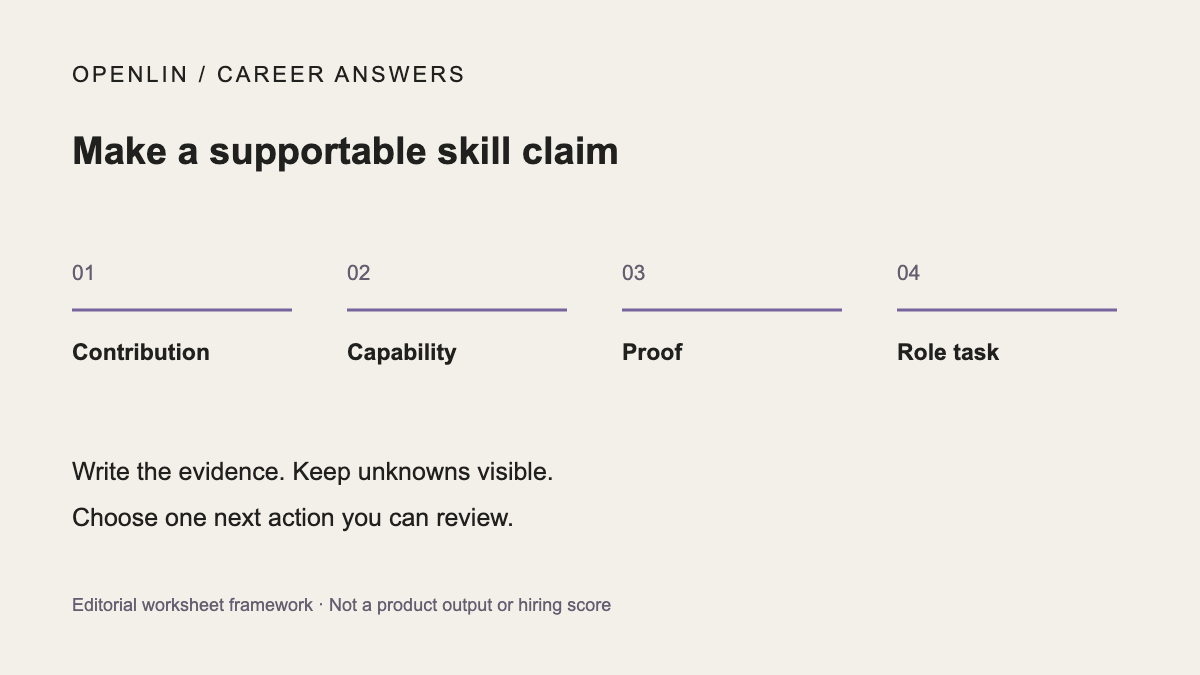
Choose one experience you can explain
A useful starting point is one project, difficult situation or recurring responsibility you remember clearly. Paid work, volunteering, study projects and other responsibilities may give you examples. Choose details relevant to the target task, and keep private information out of the story.
Separate the team result from your contribution. “We launched the program” does not explain what you decided or delivered. Write the part you personally handled, the constraints you faced, and what happened next. If you do not know the outcome, say so.
Connect your past work to one target responsibility
Choose one responsibility from a role you are considering. Record the posting link and the date you read it. Then find a specific contribution from your own experience that uses a similar skill. A job title alone is too broad to show the match.
For example, arranging meetings can give you evidence of scheduling and written communication. A target job may also expect you to track dependencies, manage a budget, or make decisions about project scope. Keep those expectations separate until you have evidence for them.
Use the worksheet below for one contribution at a time. Repeat it for another target responsibility only when you have a different example or a meaningful difference in scope. You do not need to fill every box with a strong claim. “I have not done this yet” is a useful answer.
Compare the work along four dimensions: the task itself, the tool, the scale, and the decisions you owned. A familiar task in a new tool may need practice. A role that gives you budget or delivery authority may require experience your earlier task did not provide.
Write what your example supports, then name the nearest boundary. “I maintained a meeting action log” supports a claim about recording and following up on actions. It does not establish that you owned the whole project.
An accurate account can be useful even when you cannot share the original document. Record what you did, what happened next, and how you know. Use a number only when you can verify it. If you make a new practice sample, label it as a practice sample; it cannot prove a past result.
Use O*NET for occupation background and vocabulary. Its administrative-assistant profile includes calendars and meeting records, while its project-management profile includes schedules, updates, and project documents. Those overlaps suggest questions to investigate. Check the actual opening because a project-coordinator title can cover a different scope.
Separate missing skills from missing proof
Swipe or scroll horizontally to see every column. Keyboard: focus the table and use the arrow keys.
| Field | Your record |
|---|---|
| My source role or setting | [Current or past role, volunteer work, study, or another relevant responsibility] |
| My target role and task | [Role title and one specific responsibility] |
| Where the target task came from | [Posting or other source, URL, and date checked] |
| The situation | [What needed to happen, and what made it difficult?] |
| My contribution | [What did I personally decide, make, change, or coordinate?] |
| The outcome I can support | [What happened next? How do I know? Write unknown if needed.] |
| The skill and the connection | [What capability does this show, and where would it help with the target task?] |
| Evidence I can use | [Accurate account, permitted sample, or permission-based reference; label any new practice sample] |
| What this does not yet show | [Different tool, scale, decision authority, knowledge, or other requirement] |
| My next small check | [One task or question, time limit, and visible output] |
| How I will review it | [What result would strengthen, narrow, or change my claim? When will I review it?] |
| The sentence I can defend | [I did ___, which is relevant to ___ because ___. I still need to demonstrate ___.] |
Example of moving from administration to project coordination
Fictional example: Nina is an administrative assistant considering a project-coordinator opening. The person, opening, and events below are invented to show how to use the worksheet. They are not a customer story or a claim about every job with these titles.
In this example, Nina helped organize an internal training session. She scheduled planning meetings, kept an action log, followed up with the people responsible, and flagged a missing slide deck to the organizer. The organizer chose to move the rehearsal. Nina updated the invitations after that decision.
The invented opening asks the coordinator to maintain a project schedule, request progress updates, and flag delivery risks to a project manager. Nina maps her contribution to those tasks before writing a general claim about project management.
Swipe or scroll horizontally to see every column. Keyboard: focus the table and use the arrow keys.
| Past contribution | Relevant target task | Boundary to keep visible |
|---|---|---|
| Scheduled planning meetings and updated invitations after a date change | Keep schedule information current and communicate changes | She updated dates after the organizer decided. This does not show ownership of a project timeline. |
| Maintained an action log and requested updates from named owners | Record actions and follow up on progress | Following up on work does not establish authority to assign work or evaluate staff. |
| Flagged a missing deck before the rehearsal | Raise a potential delay with the project manager | She reported the issue. She did not assess the full project impact or approve a recovery plan. |
Write a claim that matches the evidence
“Coordinated planning meetings, maintained an action log, and flagged a missing deliverable to the event organizer.”
Nina can explain these actions without adding a percentage improvement or claiming she led the project. Her example offers relevant evidence of coordination and follow-up. The job’s expectations for schedule ownership still need checking.
The completed worksheet below keeps the experience, its limits, and the new practice task separate.
A completed worksheet record
Fictional example: Nina’s practice task and earlier experience remain separate.
Swipe or scroll horizontally to see every column. Keyboard: focus the table and use the arrow keys.
| Field | Filled example |
|---|---|
| Source and target | Administrative assistant → the invented project-coordinator opening described above. Target task: maintain schedule information and flag delays. Source: fictional posting created for this example, not a live vacancy. |
| Situation and contribution | The slide deck was missing before a training rehearsal. Nina checked the action log, asked the owner for an update, and told the organizer that the deck was still outstanding. After the organizer changed the rehearsal date, Nina updated the invitations. |
| Supported outcome | The invitations reflected the organizer’s revised date. The example provides no evidence about attendance, delivery speed, cost, or whether the training improved performance. |
| Skill and connection | Written follow-up and schedule coordination are relevant to keeping a project team informed. Nina can describe the information she checked and the point at which she asked the organizer to decide. |
| Usable evidence | A truthful interview account of her actions. If a real person used a similar story, they would need their own facts. A new sample with fictional names could demonstrate an approach, but would not verify the earlier event. |
| Transfer boundary | Nina has not shown that she can identify task dependencies, estimate their impact, or choose a response to a delay. The example also says nothing about her experience with the employer’s project software. |
Choose one small test
Nina sets aside 45 minutes to make a practice schedule for a fictional training session. She lists the tasks, owners, due dates, and dependencies. She then moves the slide-deck delivery two days later and writes a short update identifying what may be affected and which decision belongs to the project manager. The 45-minute limit is her chosen practice budget, not a recommended standard.
Her output is one schedule and one update, both labeled as fictional practice. She checks whether the dependency links explain why a date may move and whether the update separates a fact, an assumption, and a decision request. If she cannot explain the effect of the delay, she practices that part before making a broader claim. If a willing practitioner reviews it, she records the feedback rather than treating approval as proof she meets the whole role.
After the practice attempt, Nina reviews her coordination claim, adds only what the sample actually demonstrates, and records any unresolved tool or dependency-planning questions. She has no basis to claim a completed career transition or improved hiring chances.
Check the claim before you use it
Read the sentence as if an interviewer asked, “What did you do, and how do you know?” You should be able to explain the action, context and outcome without inventing a metric.
Do not upload internal documents, customer information, employee records or sensitive personal details to prove a skill. Redaction alone may not make a document safe or authorized to share. Use a public example or a clearly labeled fictional reconstruction when permission is uncertain.
If you cannot explain your contribution, narrow the claim. If you can explain it but the target role requires a different scale or tool, record that limit. Your next step may be a small practice task or a conversation about the requirement, rather than another general skills list.
Sources and limits
The worksheet, role comparison and practice criteria are Openlin editorial methods, not a validated assessment or hiring forecast. O*NET supports the occupation-task background; verify the actual opening and any required credential separately. Sources reviewed October 5, 2026.
Prepare one supportable skill claim
Write one skill claim using the worksheet. The preview is illustrative and does not assess your experience. Openlin’s waitlist provides early access updates without confirming product access.
Before you explore the preview, write down one contribution, one target responsibility, and the part you still need to test. Keep confidential employer and personal information out of your notes for sharing.
A starting note to adapt
I [describe my contribution]. The target role requires [specific task]. Help me connect the two, state the evidence and limits, and choose one small check for the part I have not demonstrated.