
CAREER ANSWERS
How to Choose a Career Change

THE SHORT ANSWER
Put two possible career paths beside the conditions your next job must meet. Compare the work, the evidence you already have, and the unanswered questions. Choose one path to test next. If both break a non-negotiable constraint, reject both and change the search.
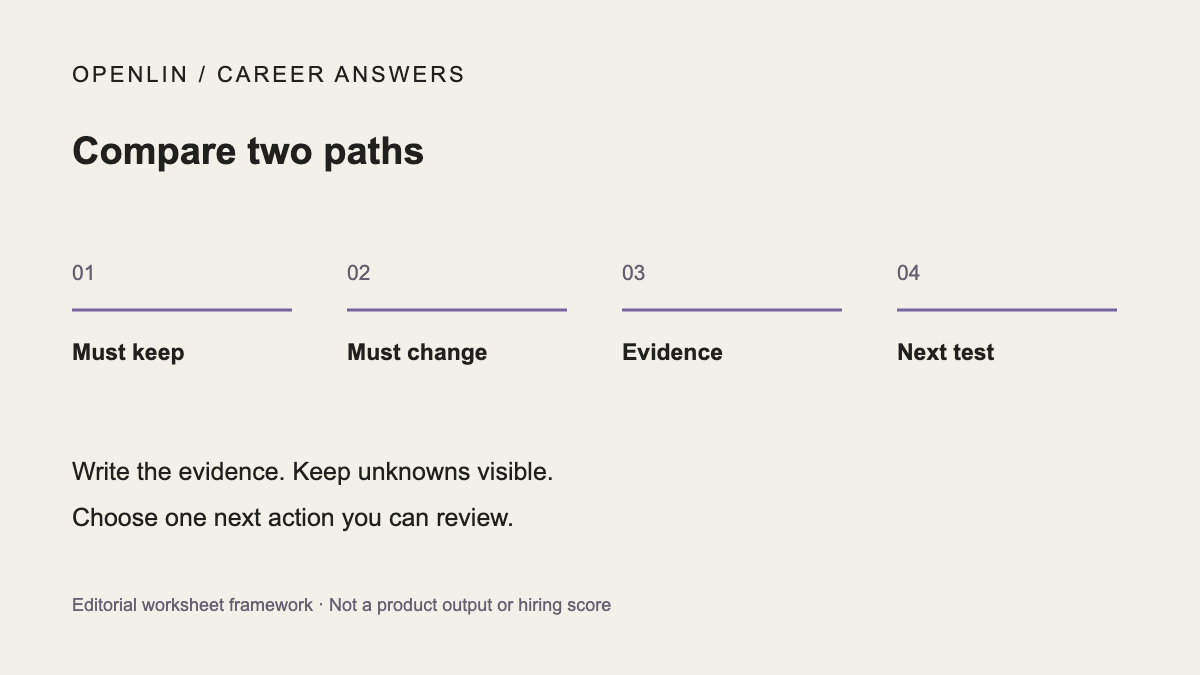
Decide what must stay and what must change
Start with a few facts: your current work, two roles you are considering, one condition you must protect, and one thing you want to leave behind. You do not need a complete career history to make the first comparison.
A must-keep is a condition you cannot reasonably give up, such as an income floor, a workable commute, or predictable hours. A must-change describes the actual problem: recurring night shifts, constant interruptions, or too little ownership. “A new industry” is a possible solution, not yet a reason.
Use the same criteria for both paths. Record unknown when you cannot verify an answer. An attractive title should not turn an unanswered question into a yes.
Fill in a two-path comparison
Copy the worksheet below into a note. Replace each prompt with evidence or a question. Record the source and date beside job-specific details so you can revisit them.
For U.S. occupation research, O*NET describes tasks, skills and work context. The BLS Occupational Outlook Handbook covers duties, typical preparation, pay and outlook. These give you background; current employer postings and conversations help you test the particular jobs you might pursue.
Treat a published occupation median as context, not your likely starting offer. Compare actual compensation and working arrangements where available. Check benefits, hours and location alongside base pay.
Swipe or scroll horizontally to see every column. Keyboard: focus the table and use the arrow keys.
| Criterion | Path A | Path B | Evidence or next question |
|---|---|---|---|
| Daily work | [Tasks you would spend time doing] | [Tasks you would spend time doing] | [Posting, occupation source or practitioner; date] |
| Must keep | [Does this protect your constraint? Yes / No / Unknown] | [Yes / No / Unknown] | [What would verify it?] |
| Must change | [Does it address the problem?] | [Does it address the problem?] | [Evidence, not title alone] |
| Relevant experience | [One contribution you can explain] | [One contribution you can explain] | [What it proves and what it does not] |
| Unknowns | [Most important unanswered question] | [Most important unanswered question] | [Cheapest credible check] |
| Decision | [Test / Hold / Reject] | [Test / Hold / Reject] | [Reason and next review point] |
Example: keep one path, reject the other
Fictional example: Maya leads a customer-support team and is considering product operations or implementation coordination. The details below are invented to demonstrate the worksheet, not customer results or claims about every job with these titles.
Maya keeps product operations as a candidate because her escalation-workflow experience gives her something relevant to test. She rejects the specific implementation opening because its stated travel schedule conflicts with a must-keep. That does not rule out every implementation role.
Her next test is a fictional support-to-product handoff: map the issue, name the owner at each stage, and describe what happens when information is missing. She asks a willing practitioner whether the sample resembles the work. A useful result may be “this is not the kind of work I want.”
Swipe or scroll horizontally to see every column. Keyboard: focus the table and use the arrow keys.
| Criterion | Product operations opening | Implementation coordinator opening | Decision evidence |
|---|---|---|---|
| Daily work | Process handoffs and issue triage | Customer setup and rollout coordination | Invented posting summaries for this example |
| Must keep | No required travel stated; still confirm | Frequent travel explicitly stated | Maya needs to remain local |
| Must change | Potentially more process ownership | Potentially more project coordination | Neither title alone verifies less interruption |
| Relevant experience | Rebuilt an escalation workflow | Coordinated support handoffs | Scope of ownership still needs explaining |
| Unknown | Who owns the process after a problem is raised? | Are any comparable openings travel-free? | Ask before treating fit as confirmed |
| Decision | Test with a fictional handoff sample | Reject this opening; keep the role family open | Review product-operations fit after feedback |
Make a decision you can revise
End with one of three decisions: test this path, hold it until an important unknown is resolved, or reject it under your current constraints. Write the reason in a sentence.
Set the test before spending heavily on training or making an irreversible change. For example: “Continue if the schedule fits and I can explain why I want to do the sample task again; revise if either remains unclear.” This is a personal decision rule, not a validated hiring predictor.
If both paths fail, identify which assumption to change: the role, employer type, geography, timing or a negotiable preference. Do not lower a true non-negotiable just to finish the worksheet.
Sources and limits
The worksheets and fictional examples are Openlin editorial guidance, not validated hiring assessments. These sources describe occupations and preparation; verify the specific opening and any required credential separately.
Take the next step
Use the worksheet now. To explore Openlin, view the product preview or join the waitlist for early access updates. The preview is illustrative; joining the waitlist does not start this task or confirm product access.
For a focused starting point, prepare two role names, one must-keep and one must-change. Leave out confidential employer or personal details.
A starting note to adapt
Help me compare [path A] and [path B]. I must keep [constraint] and want to change [problem]. Identify the biggest unknown and one small test before I commit.