
CAREER ANSWERS
Informational Interviews for a Career Change: Email Template and Questions

THE SHORT ANSWER
Use an informational interview to answer a question about work you are considering. Find someone close to that work, ask for a short conversation, and prepare questions that could change your next step.
You might need to understand the daily tasks, the experience employers value, or how a schedule works in practice. A useful conversation leaves you with clearer information and a better question to check next.
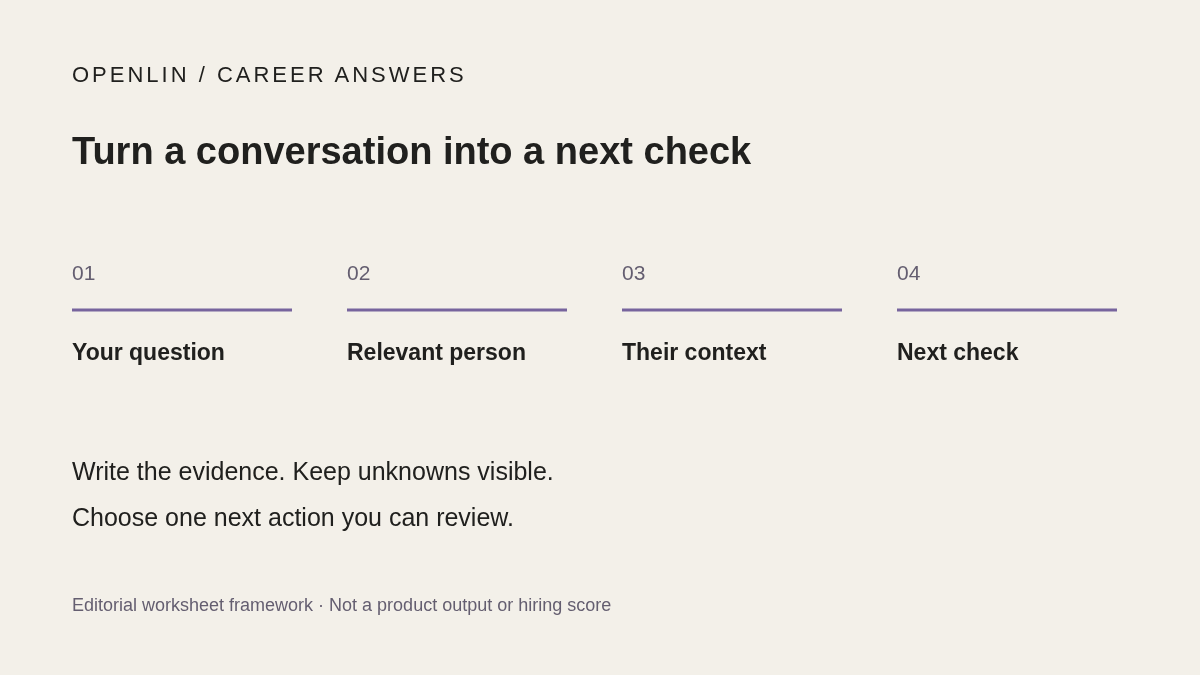
Choose what you need to learn
Before looking for someone to contact, finish this sentence:
“I am considering [role or type of work], and I need to understand [specific uncertainty] before I [next decision].”
For example:
“I am considering implementation coordination, and I need to understand how customer launches affect working hours before I prepare applications.”
This helps you choose the right person. Someone doing that work can describe their experience. A person who changed from your previous field may also explain which parts of their background proved useful. A recruiter may be better placed to clarify a particular opening’s stated requirements.
If your options are still broad, use the career-change comparison to identify the question most likely to affect your choice.
Find someone close to the work
Start with people you already know, public professional profiles, alumni communities you legitimately belong to, or professional groups that welcome career questions. Read enough about the person’s work to explain why you are asking them.
The Berkeley Career Engagement guide recommends researching the field before making contact, preparing open-ended questions, and being clear about the purpose of the conversation.
Keep the request small and specific. Do not imply a shared connection you do not have. Avoid asking someone to explain an entire industry when you could first read a public role description.
Copy and personalize this email
Subject: Question about your work in [role]
Hi [Name],
I’m currently [actual background] and exploring [target work]. I found your [public profile or article] through [accurate source].
Would you be open to a 20-minute conversation about [specific question]? I’m hoping to understand the work before choosing my next step. If email is easier, I can send two questions instead.
Thank you,
[Your name]
Replace every bracket before sending. Choose a time request you can respect, and let the person suggest a convenient format. The 20-minute request is an example, not a requirement.
If a mutual contact suggested the introduction, name them only when you have permission and it is accurate. If you are actively job hunting, there is no need to pretend otherwise. You can say you are exploring the work and want advice before deciding where to apply.
CareerOneStop’s informational-interview guidance describes these conversations as a way to learn about someone’s real experience. Keep that purpose clear instead of attaching an unexpected request for a referral.
Choose questions that address your decision
You will probably learn more from a few well-chosen questions and follow-ups than from rushing through a long list.
For daily work:
“What took most of your time last week?”
Follow-up:
“Is that a typical week, or was something unusual happening?”
For responsibility:
“Which decisions do you make yourself, and which do you take to someone else?”
Follow-up:
“What would a person new to the role usually own?”
For entry into the field:
“What experience would you want someone with my background to demonstrate?”
Follow-up:
“What kind of example would make that experience easier to understand?”
For a concern about fit:
“What do people often misunderstand about this work?”
Follow-up:
“Could you give me an example?”
For the limits of the conversation:
“Which parts of your experience are specific to your team or employer?”
Follow-up:
“Where would you suggest I look for a different perspective?”
Add a question about a condition you need to protect. If predictable hours matter, ask how deadlines, launches, or urgent requests affect the schedule. You can discuss a work requirement without sharing private reasons for it.
Do not ask for confidential customer details, internal records, or information the person is not comfortable sharing.
Keep the conversation focused
Open with a brief explanation of your background and what you hope to learn. Let the other person do most of the talking. If an answer is broad, ask for an example rather than assuming you understand.
Take brief notes if that works for both of you. Ask permission before recording. As the agreed time approaches, identify your most important remaining question and leave room to thank them.
If they offer an introduction or feedback, clarify what they are comfortable doing. Permission for a conversation does not automatically include permission to forward their comments or contact someone in their name.
Turn the answers into a decision note
Write down what you learned while the conversation is fresh. Separate the person’s experience from your own interpretation.
This distinction matters when advice sounds universal. “Our team works some evening launches” tells you something about that team. It leaves the working arrangements at another employer unresolved.
Use job-market research to compare the conversation with current postings and other relevant sources. Differences are useful: they may show that you need to narrow the role, employer type, or level you are researching.
A fictional example of a changed decision
Elena supervises retail shifts and is considering implementation coordination. She wants more predictable hours. Before applying, she asks an implementation coordinator how customer launches affect the team’s schedule.
Everything in this example is invented, including the people and their conversation.
The coordinator describes occasional evening launches at their company. They also say their experience may differ from other teams and employers. Elena asks how far ahead the work is scheduled, but the answer does not tell her what the employer in her target posting would expect.
Her completed decision note reads:
Question:
Would this opening give me the predictable hours I need?
What I learned:
The practitioner’s team sometimes covers launches outside regular hours.
Scope:
One person’s experience at one company.
Still unknown:
Whether my target opening involves evening launches, how often, and how much notice is given.
Effect on my decision:
Hold this application until I clarify the schedule.
Next check:
Review the employer’s posting and ask the appropriate hiring contact how launch coverage is arranged.
Elena has not ruled out the whole occupation. She has identified a specific condition to check before investing more time in this opening.
Copy this conversation worksheet
Swipe or scroll horizontally to see every column. Keyboard: focus the table and use the arrow keys.
| Field | Your notes |
|---|---|
| Role or opening I am exploring: | [Details and source] |
| Decision I am trying to make: | [Apply, compare paths, choose training, or another decision] |
| Question that could change it: | [Specific uncertainty] |
| Why this person may know: | [Relevant role or experience] |
| Questions I want to ask: | [A short selection] |
| Agreed time and format: | [Details] |
Swipe or scroll horizontally to see every column. Keyboard: focus the table and use the arrow keys.
| Field | Your notes |
|---|---|
| Person’s role and context: | [Only the information needed for these notes] |
| Date: | [When we spoke] |
| What they described: | [Their experience or view] |
| What I inferred: | [My interpretation] |
| What remains unknown: | [Questions still open] |
| Effect on my decision: | [Continue, revise, hold, or stop, with a reason] |
| Next check: | [Source, person, or small task] |
| Permission for follow-up or introductions: | [What was actually agreed] |
Keep the note private unless you have permission to share the person’s remarks.
Send a specific thank-you
A short message can acknowledge what was useful without making a promise you will not keep.
Hi [Name],
Thank you for explaining [specific part of the work]. Your example helped me understand [what became clearer]. I’m going to check [next question] as I compare my options.
I appreciate your time,
[Your name]
Only include the next step if you intend to take it. If the person invited an update, you can share one when you have something useful to report.
Common questions
What if I do not know anyone in the field?
Look for a relevant public professional profile or a community where career questions are welcome. Explain how you found the person and why their experience fits your question. Avoid sending the same broad request to a large list.
What if nobody replies?
A missing reply does not tell you whether the career is a good fit. Revisit the clarity and size of your request, then continue using public sources or another appropriate contact. Respect a refusal, and do not keep pursuing someone who has not agreed to talk.
Can I ask for a referral?
Treat a referral as a separate request. First establish whether the role is relevant and whether the person is comfortable discussing an introduction. Do not assume that accepting a conversation commits them to recommending you.
What if two people give different answers?
Record the context behind each answer: employer, team, seniority, and date. Both may be describing their experience accurately. Decide which difference matters for the opening you are considering and check that point directly.
Sources and limits
Sources checked October 8, 2026: Berkeley Career Engagement and CareerOneStop guidance linked above. The email templates, questions, and worksheet are original editorial guidance. Treat the conversation as one perspective; verify an opening’s requirements and compensation with the employer, and do not assume a hiring outcome.
Choose the next step
Put the unanswered question and your next check into a career action plan. Once the target is clear enough, use the career-change resume examples to prepare application wording.
You can also explore the Openlin preview or join the waitlist for early access updates. The preview is illustrative, and joining does not arrange a conversation or confirm product access.