
CAREER ANSWERS
Career Change Resume Summary Examples and Bullet Rewrites

THE SHORT ANSWER
A career-change resume summary should connect the work you have done to the job you want. Name your actual background, choose relevant contributions, and explain the connection in plain language. The bullets beneath it should give the reader something concrete to ask you about.
You can do this without changing your past job titles or adding a result you cannot verify. Start with one job posting and finish with a short summary and a few experience bullets tailored to its work.
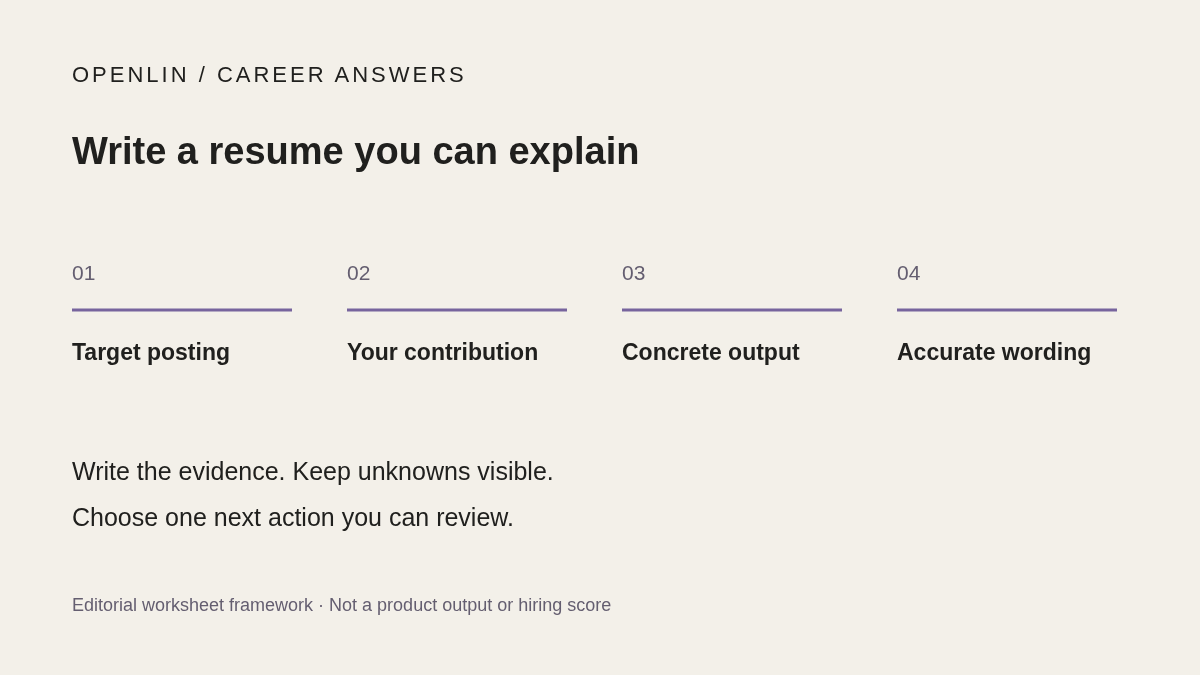
Start with one target posting
Keep the posting beside your draft. Pick the responsibilities that matter most to the work and that you have some basis to discuss. A request to “maintain accurate customer records,” for example, gives you a more useful writing prompt than the title “customer support specialist.”
For each responsibility, find a relevant contribution from your own experience. Write what you personally did, what you produced, and any result you can support. If the whole team delivered an outcome, explain your part.
If you are still struggling to identify that evidence, start with the transferable-skills worksheet. This article takes the next step: turning selected evidence into resume wording.
A requirement you have not met belongs in your planning notes. Do not quietly turn it into a resume claim. Use the skill-gap guide to decide whether it needs practice, clarification, or a different target.
Write the summary after the bullets
A useful summary gives the reader a quick explanation of the connection between your experience and the opening. CareerOneStop describes the summary as an optional place to highlight relevant skills and accomplishments, including how experience carries into another field. Its resume top-section guide also advises avoiding inflated language and jargon.
Try this starting point:
“[Actual background] with experience in [relevant work] and [another relevant contribution]. Bringing [specific experience] to a [target role] focused on [responsibility in this posting].”
Then edit it until it sounds like something you would say. You do not need every part of the formula, and a summary is optional. If it merely repeats the first bullets or says you are motivated and hardworking, shorten it or remove it.
Keep the target role separate from your employment history. You can say that you are applying to a training-coordinator role while keeping “Teacher” as the title of your previous job.
Example one: retail supervisor to customer support
This example is fictional. The applicant, posting, and work described below are invented to demonstrate the editing process. They are not a customer story or evidence of a successful application.
The imagined opening asks for someone who can handle escalated questions, document cases, and share recurring issues with colleagues.
Before:
“Hardworking leader seeking an exciting opportunity to use excellent people skills.”
After:
“Retail supervisor with experience resolving customer complaints, documenting follow-up, and training new colleagues. Bringing that experience to a customer-support role focused on clear communication and dependable case handling.”
The revised version names work the applicant can explain. It also gives the experience section a clear job: support those statements.
Before:
“Responsible for customer service.”
After:
“Handled escalated return questions, recorded unresolved cases, and passed policy exceptions to the store manager.”
Before:
“Helped with staff training.”
After:
“Grouped recurring customer questions into a reference sheet and used it when training new colleagues.”
Before:
“Worked with the team to solve problems.”
After:
“Reviewed open customer issues during shift handoffs and identified which cases needed a manager’s decision.”
These bullets do not claim that the applicant has used a particular ticketing platform or supported a software product. If the opening requires that experience, it remains a separate question. Adding the platform’s name because it appears in the posting would make the resume less accurate.
Example two: teacher to training coordinator
This is another fictional example. The imagined opening involves preparing session materials, coordinating schedules, and helping participants access the information they need.
Before:
“Passionate educator ready for a new challenge in a dynamic company.”
After:
“Teacher experienced in preparing learning materials, coordinating session schedules, and collecting participant feedback. Interested in applying that experience to training coordination and learner support.”
Possible experience bullets:
- “Prepared session materials and step-by-step instructions so participants could complete the planned activities.”
- “Coordinated session dates with colleagues, maintained an attendance record, and shared schedule changes.”
- “Revised instructions after participants repeatedly asked for clarification about the same activity.”
The wording shows relevant preparation and coordination. It does not establish experience running a corporate learning platform, owning a training budget, or managing a company-wide program.
Notice that neither example needs a percentage. A concrete account of an output can be useful when no reliable outcome measurement exists. CareerOneStop’s work-experience guide recommends emphasizing relevant responsibilities and accomplishments, including transferable experience when the target work is new to you.
Copy this resume-writing worksheet
Complete one record for each bullet you are considering.
Swipe or scroll horizontally to see every column. Keyboard: focus the table and use the arrow keys.
| Field | Your draft |
|---|---|
| Target posting: | [Employer, role, URL, and date checked] |
| Relevant responsibility: | [One task from the posting] |
| My actual experience: | [Where and when I did related work] |
| My contribution: | [What I personally did, decided, or made] |
| Result or output: | [What happened or what I produced; use a number only if I can support it] |
| Important limit: | [What this experience does not show] |
| Draft bullet: | [Action + relevant work + useful context or supported result] |
| Final check: | [Could I explain this clearly if an interviewer asked for details?] |
Once you have chosen the strongest bullets, write the summary above them. Check that every important summary claim has support elsewhere in the resume.
Check the wording before you submit
Read the draft aloud. Replace vague phrases such as “results-driven professional” with the work you actually did. Keep terms from the posting when they accurately describe your experience, and remove terminology you could not explain.
Then check:
- Employment titles, dates, and credentials match your records.
- Team results are distinguished from your contribution.
- Numbers have a basis you can explain.
- Practice projects are clearly labeled.
- Tools listed as skills are tools you can actually use at the stated level.
- The document follows the employer’s application instructions.
Keep confidential employer and customer information out of the resume. A clear description of your contribution often provides enough context without exposing an internal document.
For a customer-success to product-management move, use the role-specific transition guide alongside this writing process. It addresses the product decisions and experience that require closer examination.
Common questions
What if I have no measurable results?
Describe the output and its purpose. “Created a reference sheet for recurring customer questions” is more informative than “excellent communicator.” Do not estimate an improvement just to add a number.
Should I call myself the target job title?
Make your target clear without presenting it as a job you already held. Keep official employment titles in your work history. If a title is unfamiliar, explain the responsibilities underneath it.
Can I include a practice project?
Yes, if it is relevant and accurately labeled as a practice or personal project. Describe what you made and what it demonstrates. Do not place a fictional exercise inside an employer’s work history or present simulated results as real performance.
What if I still do not understand the target role?
Pause the writing long enough to answer the important question. An informational interview can help you understand how the work is done at a particular organization. Check that perspective against the actual opening.
Sources and limits
Sources checked October 8, 2026: CareerOneStop’s resume top-section and work-experience guides linked above. The examples and worksheet are original editorial guidance for ordinary U.S. civilian resumes. Follow the instructions for the particular application.
Take the next step
Save the summary and bullets with the posting they were written for. When you apply elsewhere, review the match again. The goal is a resume you can explain confidently and accurately; no wording can guarantee an interview.
You can also explore the Openlin preview or join the waitlist for early access updates. The preview is illustrative, and joining does not perform this exercise or confirm product access.