
CAREER ANSWERS
How to Find Skill Gaps for a Target Role

THE SHORT ANSWER
Put the target role’s requirements beside evidence of what you can already do. Mark each requirement as essential, preferred or unknown, then distinguish a skill gap from a proof gap or credential requirement. Work first on what could block the role, rather than the tool mentioned most often.
Read requirements in context
Start with an opening you would seriously consider. Record its employer, location, level, source URL and date. Add comparable openings when useful, keeping different seniority levels and locations separate.
Use “essential” when the employer explicitly identifies a requirement as mandatory, “preferred” when it says the requirement is optional or desirable, and “unknown” when the wording is unclear. A frequent phrase does not prove that every employer treats it as a hard requirement.
If a license, registration or other credential appears to be required, verify the relevant official authority and the employer’s requirement before choosing training. BLS describes licenses, certifications and educational certificates as distinct categories; licensing rules can vary by state.
Build a requirement-to-evidence table
Keep the exact requirement or a faithful short summary. Beside it, write the task you can perform and the evidence that supports it. “I know the tool” is less useful than an example of the work you completed with it.
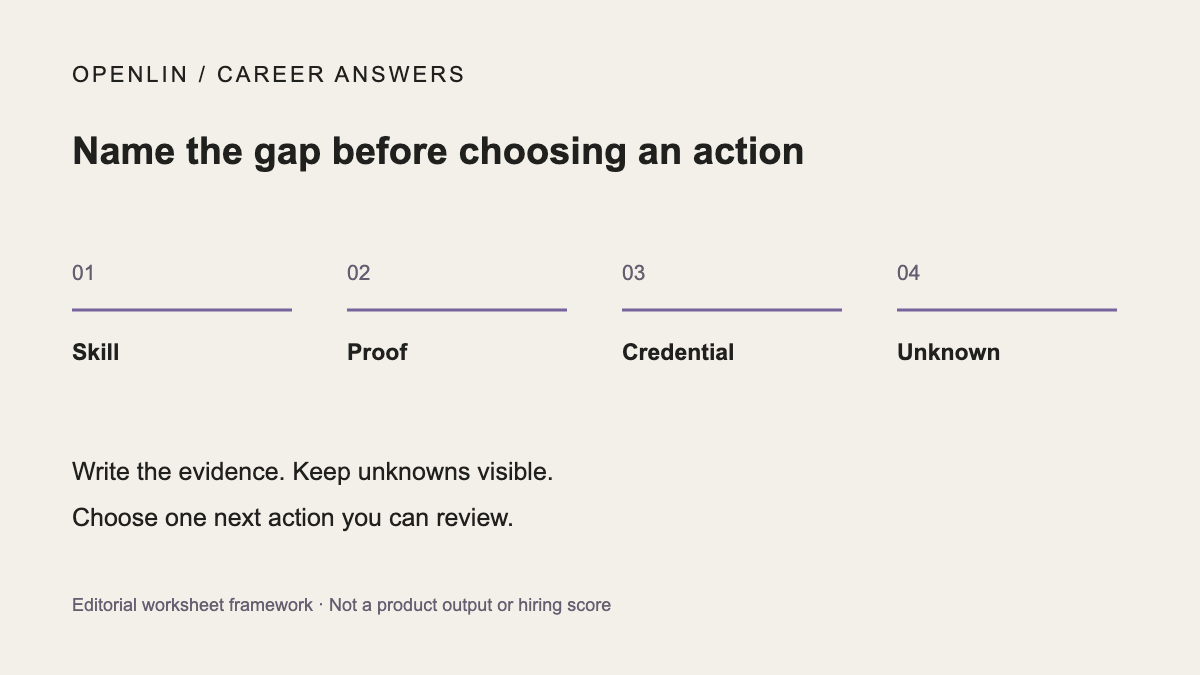
Use “skill gap” when you still need to learn or practice the task, “proof gap” when you can do it but lack a credible example to show, and “credential gap” when a stated qualification remains unmet. More than one label may apply. Use “unknown” when you need more information.
Do not treat a single failed practice attempt as a diagnosis of your ability. Unclear instructions, unfamiliar tools or lack of feedback may be part of the problem. Write the task and the conditions you need to test next.
O*NET can help you cross-check occupational tasks and preparation. It does not tell you an individual employer’s private hiring criteria. There is no universal rule that a requirement becomes essential after appearing in four of ten postings; counts are a research aid, not an eligibility score.
Swipe or scroll horizontally to see every column. Keyboard: focus the table and use the arrow keys.
| Requirement and source | Essential / Preferred / Unknown | Evidence you have | Gap type | Next action and check |
|---|---|---|---|---|
| [Wording; employer, URL, date] | [Use stated wording; do not infer from frequency alone] | [Specific task, artifact or accurate account] | [Skill / Proof / Credential / Unknown / None identified] | [One output or verification; how to review it] |
Example: a project-coordination target
Fictional example: Priya is comparing her experience with a fictional project-coordinator opening. She has maintained meeting notes and followed up on action items, but has not built a dependency-based project schedule. The table separates the work she needs to practice from experience she needs to document.
Her next action is to build a schedule for a fictional community event, showing task owners, dependencies and a delayed task. She will compare it with the brief and seek feedback if a reviewer is available. The sample demonstrates an approach; it does not establish delivery experience on a real client project.
Swipe or scroll horizontally to see every column. Keyboard: focus the table and use the arrow keys.
| Requirement and source | Essential / Preferred / Unknown | Evidence you have | Gap type | Next action and check |
|---|---|---|---|---|
| Maintain action logs; fictional posting | Essential | Priya has done this, but has not prepared a shareable example | Proof | Write a factual account of her contribution; remove restricted details |
| Build a project schedule; fictional posting | Essential | No dependency-based schedule completed yet | Skill | Create a fictional event schedule; check owners, dependencies and delay handling |
| Specific project-management certification; fictional posting | Preferred | No certification held | Credential, lower priority | Check whether target employers accept experience before paying for certification |
| Advanced spreadsheet skills; fictional posting | Unknown: “advanced” is undefined | Can sort, filter and maintain a tracker | Unknown | Identify the actual spreadsheet task; test it before assigning a gap |
Choose one gap to address first
Resolve a possible hard blocker before spending money. Next, choose an important task where a small piece of work could improve your ability or your evidence. Record the output and how you will judge it.
Decide whether this opening is worth preparing an application for. Apply when the work fits your constraints and you can honestly show relevant evidence for the core tasks, even if some preferred items are missing. Hold the application while you verify a possible required license, work authorization condition, schedule conflict or other hard blocker. Skip this opening when a confirmed requirement conflicts with a condition you cannot change. These are effort decisions, not predictions of hiring success.
For a proof gap, write a short account of work you already did, using details you may share. For a skill gap, practice the missing task and inspect the result. For an unclear credential requirement, verify it before enrolling.
Do not turn the table into a percentage chance of getting hired. Employers can weigh requirements differently, and completing a sample or course does not guarantee an interview.
Sources and limits
The worksheets and fictional examples are Openlin editorial guidance, not validated hiring assessments. These sources describe occupations and preparation; verify the specific opening and any required credential separately.
Choose the next gap to address
Use the worksheet now. To explore Openlin, view the product preview or join the waitlist for early access updates. The preview is illustrative; joining the waitlist does not start this task or confirm product access.
Start with one target responsibility and a short description of the closest work you have done. Add whether the opening calls it required or preferred.
A starting note to adapt
The role asks for [requirement; required/preferred/unclear]. I have done [evidence]. Help me distinguish a skill gap, proof gap or credential issue and choose one small next action.