
CAREER ANSWERS
Plan for a Promotion With a Promotion Packet Template

THE SHORT ANSWER
Start with your employer’s next-level criteria. Keep a dated record of what you did, what changed, and the evidence you can use. Then select the relevant examples for a promotion packet and review the gaps with your manager before the decision window. The templates below help you prepare that conversation; your employer’s process determines the format and the decision.
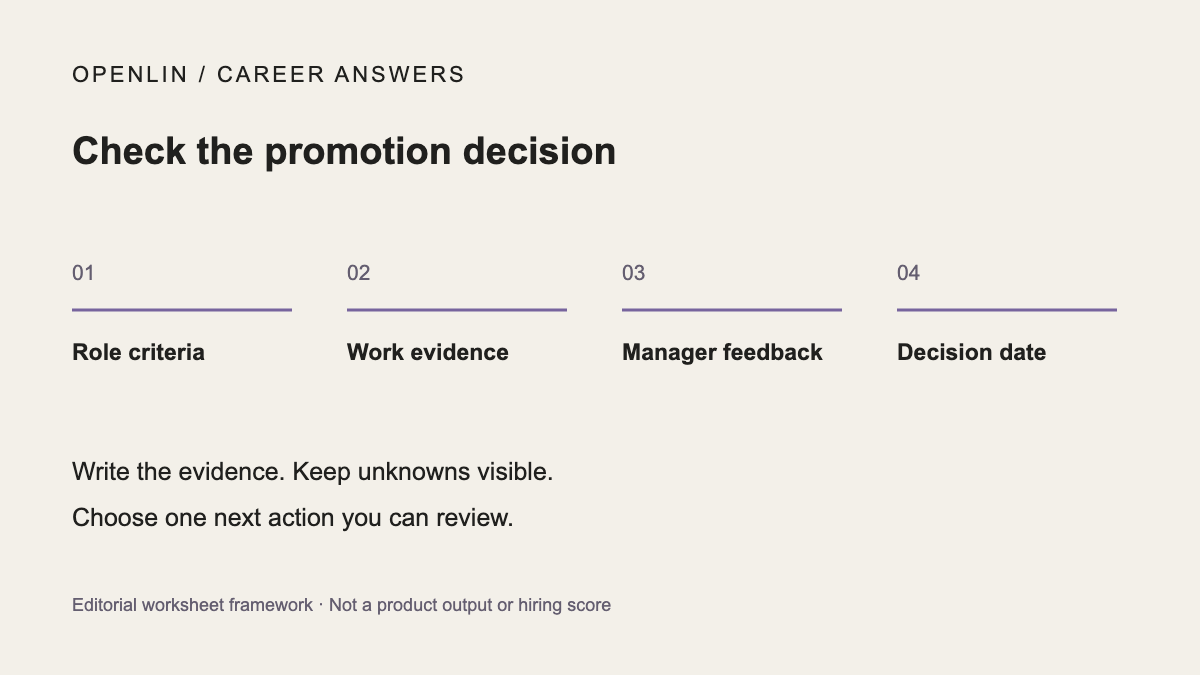
When this guide is useful
Use this guide if you are doing good work but the next level still feels unclear, your accomplishments are hard to reconstruct, or feedback arrives too late to act on. It covers a workplace promotion case. Academic tenure, regulated appointments, and other formal processes may require a different packet.
Use a brag document to build your promotion packet
A brag document is an ongoing record of your contributions, feedback, and outcomes. A promotion packet selects the evidence relevant to a particular level and review. Keep the log useful even when a promotion is months away, then build the packet around the criteria your employer actually uses.
Julia Evans describes using a brag document to remember work, reflect on its themes, and help a manager understand contributions that might otherwise be missed. Her first-hand guide to brag documents is a useful starting point. The templates here focus on turning that record into a specific promotion discussion.
Confirm the next level and the review process
Before adding more work to your plate, ask your manager these questions:
Which written criteria and role description will be used? What would a convincing example look like here?
Which expectations do I already meet, and which one or two gaps matter most?
Who prepares the packet, who reviews it, and when is the submission deadline?
Is the next step an in-level promotion, an application for an open role, or another process?
Does the role need approval, available scope, or budget? Which parts are still unconfirmed?
For one company-specific example, GitLab’s promotion guidance connects documented impact and readiness with business need. Your employer may use different criteria, a different author, and a different length. Confirm those details before adopting any public template.
Keep the criterion and evidence together
Copy one record for each important criterion. A planned assignment belongs in the plan until you have an observed result. If the assignment needs extra capacity, agree on what will be paused, who can make decisions, and where the work ends.
Swipe or scroll horizontally to see every column. Keyboard: focus the table and use the arrow keys.
| Field | Your record |
|---|---|
| Criterion | [Employer’s wording, source, and the behavior or scope expected] |
| Agreed assignment | [Bounded work, your authority, available time, and what it could demonstrate] |
| Contribution and evidence | [Your decisions or actions; baseline; observed result or pending; permitted artifact] |
| Reviewer and timing | [Manager, decision group, submission date, next check-in; mark unknowns] |
| Blocker or limit | [Missing proof, resources, access, disagreement, or a result not yet measured] |
If the gap is cross-team direction, ask for work where you can demonstrate a decision across teams. More tasks at the same scope may leave that gap unresolved. For help choosing the next assignment, separate a skill gap from a proof gap.
Brag document template
Keep this in a place approved for your work information. Add a short entry after a useful result or at a regular check-in that you can sustain. Record collaboration, documentation, prevention work, and feedback as well as visible launches. You can use the same fields without a numerical metric.
Copy this entry for each contribution
Date and project [When the work happened; project or responsibility]
Context [The problem, who needed it solved, and the starting condition]
My contribution [What I decided, delivered, changed, or helped someone else do]
Scope and collaborators [Teams or responsibilities involved; credit for others’ work]
Observed outcome [What changed; measurement and period if known; otherwise describe the observation or write pending]
Evidence and feedback [Permitted link or record; who observed the work; date of feedback]
Criterion this may support [Exact employer criterion, or not yet mapped]
Limits and next check [Unproven effect, incomplete work, missing comparison, or question to revisit]
Keep facts separate from interpretation. A launch date can show that something shipped. It does not establish improved retention, revenue, or reliability. If you use a metric, retain its definition, source, comparison period, and relevant caveats. If you do not have a reliable metric, use a specific, supportable observation.
Keep employer records within approved systems. Before sharing a log, remove unrelated personal information and check who can access each linked artifact. Do not upload customer details, employee records, or confidential documents to a public tool. A short permitted summary may be enough; redaction alone does not establish permission.
Turn the log into a focused packet
Group entries under the actual next-level criteria. Mark criteria with no suitable evidence.
Choose the examples that best explain your scope, judgment, and contribution. Avoid counting the same result more than once.
For each example, make the connection explicit: this action supports this criterion because of this observable behavior.
Verify dates, outcomes, permissions, and individual credit. Label incomplete work and uncertain effects.
Ask your manager which gaps need more evidence and which are process or business constraints. Agree on the next review point.
If an entry is hard to explain, use the transferable-skills evidence worksheet to make the contribution and its limits clearer.
Promotion packet template
Copy the sections below into your employer’s required format. Use the person and voice that process requires. First person is used here for a working draft. Ask your manager which sections they own and how much detail the reviewers need; there is no universal packet length.
1 Request and review details
Current role and target level [Current role] → [Target role or level]
Period covered [Start date] to [End date]
Process and timing [Submission deadline; review window; owner; decision group]
Request I would like to be considered for [level] in [review window]. My strongest evidence is [contribution] and [contribution], which relate to [named criteria]. I would like feedback on whether the evidence is sufficient and what still needs to be demonstrated.
2 Criteria and supporting evidence
Repeat this short section for each criterion you need to address.
Criterion [Exact wording and source]
Evidence [Example name; dates; your contribution; observed result; approved source]
Why it is relevant [The scope, autonomy, judgment, collaboration, or other behavior demonstrated]
Limit or gap [What the example does not establish; additional evidence needed]
3 Contribution examples
For each selected example, complete this paragraph and keep its evidence nearby:
The problem was [specific situation and starting condition]. I was responsible for [scope], working with [collaborators]. I [decision or action] because [reason or tradeoff]. The observed outcome was [verified result, including period if relevant]. This supports [criterion] because [specific connection]. The evidence is [permitted artifact or feedback]. The remaining limit is [uncertainty, unresolved effect, or scope not demonstrated].
4 Collaboration and feedback
Collaboration [What you did that helped others make progress; distinguish your role from their work]
Feedback [An accurate, permitted quote or clearly identified paraphrase; who observed the work and when]
Follow-through [What you changed after feedback, and the outcome if known]
Use relevant observations, with permission where needed. A collection of compliments may provide context, but the reviewer still needs to understand the work and the criterion it supports.
5 Gaps and the next assignment
Main gap [Criterion not yet demonstrated or evidence not yet available]
Agreed assignment [Bounded work, decision authority, time allocation, and collaborators]
Evidence to review [Observable behavior or result; artifact; reviewer]
Review point [Date; what will be decided; what to do if blocked]
6 Manager and process questions
Readiness question [What does the manager need to review or clarify?]
Business or role question [Scope, role availability, budget, or another constraint for the manager to confirm]
Submission next step [Owner, action, and agreed date; keep unconfirmed items explicit]
Finish with a request for a specific next step. Avoid writing an approval, recommendation, or commitment on your manager’s behalf unless they have actually made it.
Worked example from a brag entry to a packet
Fictional example: Evan is an engineer preparing for a senior-level discussion. Every person, event, artifact, and outcome below is invented to demonstrate the templates. This is not a customer story, a real promotion decision, or evidence that one project is sufficient for promotion.
The criterion and the assignment
Evan’s fictional manager identifies cross-team technical direction as an evidence gap. They agree that he will lead a bounded service-migration decision with the platform team. The assignment covers the options, dependencies, rollout sequence, and decision record. The manager remains responsible for staffing and the review process.
The running brag document
Week 1 I drafted the migration options and documented the dependency that prevented an immediate cutover. Platform engineers supplied the infrastructure constraints. Evidence: the fictional options note. Outcome: a decision is still pending.
Week 3 I facilitated a review with the service and platform teams, documented the tradeoff, and revised the sequence after feedback. Both teams agreed to the staged plan. Evidence: the fictional decision record. Limit: agreement on the plan does not establish a successful rollout.
Week 5 The teams completed the agreed migration and recorded the handoff. I coordinated the decision follow-ups; the platform team carried out infrastructure changes. Evidence: the fictional rollout and handoff record. Limit: a longer-term reliability effect has not been measured.
The condensed promotion packet
Request I would like feedback on readiness for the senior engineer level and whether this work is relevant to the next promotion review. The submission window and decision group still need confirmation.
Criterion Cross-team technical direction, as described by my manager for this fictional role.
Contribution example I led the migration decision across the service and platform teams. I compared the options, made the dependency visible, and revised the rollout sequence after the platform review. The teams agreed to and completed a staged migration. The decision record and handoff document show my role in the tradeoffs and coordination. Platform engineers owned the infrastructure changes.
Interpretation and limit This gives my manager an example of cross-team decision-making. It does not establish that I demonstrate every senior-level criterion, and I cannot claim a reliability improvement without measurement.
Next discussion Does the evidence demonstrate the expected level of direction? Which other criteria remain unresolved? If more evidence is needed, what bounded assignment would address the gap?
The packet is shorter than the log because it selects the evidence relevant to the decision. It retains the uncertainty and other people’s contributions. Evan does not turn a future assignment or an unmeasured benefit into an achievement.
Have a specific conversation with your manager
Bring the draft before the submission deadline. Ask for feedback on the evidence and the decision process, then agree on a manageable next action.
Opening the conversation
“I’d like to understand what readiness for [level] means here. I’ve mapped [examples] to [criteria]. Where is the evidence strongest, and which gap matters most? If there is a gap, can we agree on one bounded assignment and a date to review it? I’d also like to confirm the submission deadline and who makes the decision.”
When the feedback is vague
“When you say I need to show more [leadership or impact], what behavior would you expect to see? Could we look at an example of work that met the criterion and identify an assignment within my scope?”
When the constraint is outside your work
“If readiness is not the only issue, which role, budget, or timing question is unresolved? Who can confirm it, and when should we revisit it? What scope can I reasonably take on in the meantime?”
Short manager recap template
“Thanks for discussing the next-level expectations. My understanding is that the main criterion to demonstrate is [criterion]. We agreed on [assignment and scope], with [artifact or observable outcome] as evidence. I will record [baseline] and bring the work to [reviewer] on [review date]. The current blocker is [blocker or none known]. Please correct anything I misunderstood, including whether this assignment would count toward the review.”
The recap records an understanding. Keep a promised review separate from a promotion decision. If you need to define the time budget and finish line, use a bounded career action plan.
Common questions
What if I do not have numerical results
Describe what you can verify: an adopted decision, a completed handoff, a documented correction, or specific feedback from someone who saw the work. Explain why it matters and what remains uncertain. Do not invent a percentage to make the packet look stronger.
How often should I update the brag document
Choose a cadence you will keep, such as after a meaningful result or before a regular one-to-one. Add the date and evidence while the details are available. Revisit pending outcomes when you have new information.
Should I send the entire brag document
Ask what the reviewer needs. A working log can include unfinished thinking and unrelated details. Prepare a relevant selection, check permissions, and keep the underlying evidence available in approved systems.
Can a strong packet guarantee a promotion
No. A packet can make your contribution and open questions easier to evaluate. Role availability, organizational budgets, review processes, and human decisions still affect the outcome. Confirm what is in your control and avoid taking on unlimited extra work against an unclear promise.
Sources and limits
The templates and fictional example are Openlin editorial guidance, not a validated promotion assessment. Julia Evans describes a first-hand recordkeeping practice; GitLab documents one employer’s process. Verify your own employer’s criteria, format and review timing. Sources reviewed October 5, 2026.
Explore the Openlin preview
Use the templates in your own notes now. To explore Openlin, see the product preview or join the waitlist for early access updates. The preview is illustrative; it does not create your packet or perform this task. Joining the waitlist does not confirm product access.
Use your employer’s criteria and your manager’s feedback to decide whether an assignment supplies the missing evidence. The preview does not determine readiness or a promotion outcome.
For your own preparation, start with one non-confidential criterion, one contribution you can explain, and one question for your manager. You do not need to upload employer documents.
A starting note to adapt
I want to discuss [target level]. My contribution is [specific work], which may support [employer criterion]. Help me identify the evidence, its limits and one question to confirm with my manager.